The Squirrel Director and Mimosa Willamo Talk Comfort, Connection and Real Squirrels
The Squirrel director Markus Lehmusruusu and Mimosa Willamo discuss comfort, intimacy, COVID, the film’s strange future and working with real squirrels.

The Squirrel had its international premiere at Fantastic Fest this weekend, but before the screening The Fear Review sat down with writer/director Markus Lehmusruusu and star Mimosa Willamo to talk about the strange, warm and increasingly familiar world of the film.
We talked about why the movie has no obvious villain, how comfort and convenience became part of its central idea, the challenge of playing attraction in a world that has essentially removed intimacy, and what changed after COVID made parts of a script started in 2018 feel much less like science fiction.
Willamo also explains how she approached Emilia as a real person rather than simply someone enforcing the rules of the world, while Lehmusruusu gets into the decision to make that world beautiful instead of cold and oppressive. And yes, we asked about the squirrels.
You can also read or watch our full spoiler-light review of The Squirrel.
Watch The Squirrel Teaser Trailer
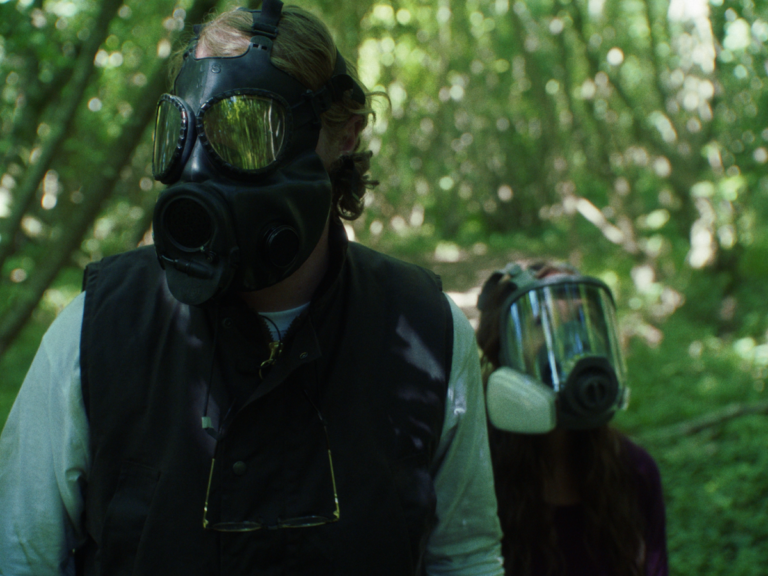
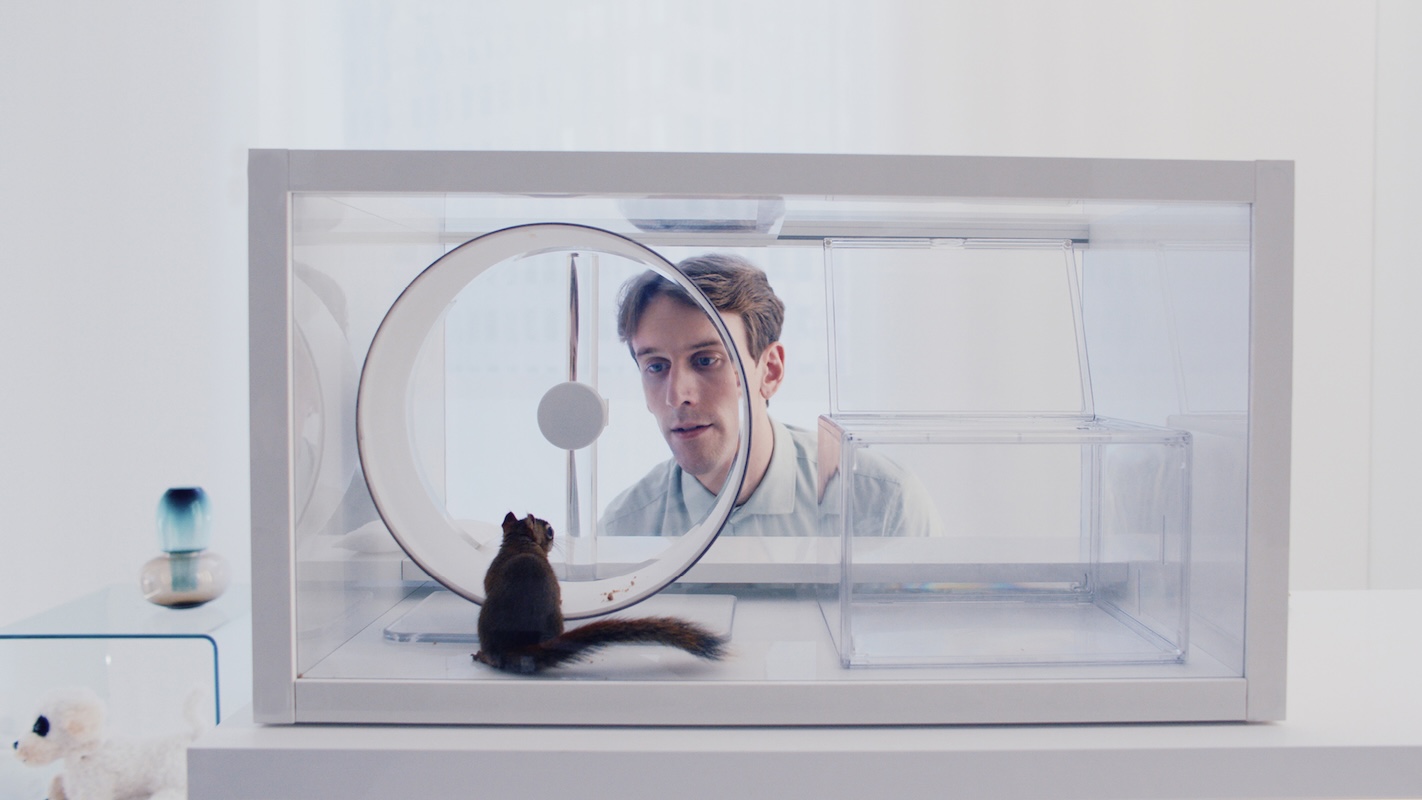
Set in a sterile future where nature and animals have disappeared, The Squirrel follows Pasi, a designer of synthetic pets who unexpectedly discovers a living squirrel. His attempt to hide and care for it brings hygiene inspector Emilia into his life and begins pulling both of them toward experiences their carefully controlled world has largely removed.
Watch Our The Squirrel Interview
We spoke with Lehmusruusu and Willamo about the ideas behind the film, its unexpectedly funny and hopeful tone, and the process of making such an artificial world still feel human.
If you would rather read it, our full conversation is below, lightly edited for clarity.
The Fear Review Interviews Markus Lehmusruusu and Mimosa Willamo
The Fear Review: One thing that really struck us is that this doesn’t feel like the usual dystopian future where some evil government took everything away. It feels like people gradually chose comfort and convenience until it removed a lot of the human experience. Was it important that there wasn’t an obvious villain behind this world?
Markus Lehmusruusu: Yeah, I think it’s great that you pointed it out. I was already on maybe the first or second draft when I realized that the biggest kind of antagonism in this film, to me, is actually indifference.
That realization made everything come together. The most scary thing is that when people actually have freedom of choice, and they choose this. It’s based on observation of myself, because that’s how I do it also. Even if my intentions are good, my indifference can lead to things that I didn’t actually want if I’m optimizing my own happiness and safety and comfort.
The Fear Review: Do you think that’s what makes it a little more unsettling, that you can understand how people got there and maybe see some of that in yourself?
Markus Lehmusruusu: Yeah. I mean, I hope so.
The Fear Review: We kept coming back to the idea that the squirrel almost mirrors the people. It’s given everything someone thinks it should need, but there’s still something fundamentally missing. Was that parallel built into the story?
Markus Lehmusruusu: Yeah, I think so, but maybe not that obviously to me. It was more about looking at human beings and our basic needs.
Pasi, and basically every character in this world, has become isolated from their own emotions and from connection. When the squirrel comes there, Pasi is trying the same tools that he happily believes work on him. At the beginning of the story, basically all of the characters believe this world is okay and nice, and of course there are a lot of good things there also.
But the squirrel brings in something real, and that relationship is forcing Pasi to realize his own needs at the same time.
Something that interested me was this thought of basic needs. What do we actually need? Thinking about artificiality versus something real was a lot of what this film was about. Where are we going as a species? We are coming up with all kinds of artificial technology that makes our life easier and at the same time gives us pleasure. The question to me was: Are we so omnipotent as a species that we can create anything, or will there be something missing? Is there something in us that we just cannot artificially replace?
The Fear Review: Mimosa, when you read the script, did you see Emilia as trapped in a way, almost like the squirrel? How did you see her coming into the story?
Mimosa Willamo: The first time I read the script, I concentrated mostly on the squirrel because that was the most exciting part for me. My first question was, how are we going to do this?
After casting and getting the role, I thought about the fact that I don’t have the experience of living in that kind of society, obviously. But I wanted to make Emilia not only the rule-obeying person working for the bad guys. I tried to think of her as a real person who just grew up there. I wanted to understand her and not think that she’s a bad person in the beginning and then maybe becomes better.
From the start, she lives in a way that she thinks is true. There are these small bits and pieces, for example when she’s alone at home, where you can see glimpses of her starting to think to herself and starting to realize that there probably is more. There is something. She doesn’t know what it is, but she wants to know. She also knows that it’s wrong in this world.
Toward the end, there are a lot of similarities between the squirrel and the human beings.
The Fear Review: When you first meet Pasi, there’s clearly something happening between them, but they live in a world that has removed intimacy. How did you play attraction in a character who may not completely understand what she’s feeling or what she’s even supposed to do with it?
Mimosa Willamo: That was one of the biggest challenges for me. I was very glad that we had some time to rehearse before filming and discuss this.
I remember especially in the beginning when we were rehearsing, there were so many things I didn’t even realize only by reading the script. We talked about senses, for example. Have these people ever smelled another human being up close? Probably not. Obviously, they haven’t touched another person, but we talked about all of the senses.
It was a challenge, but it was exciting to act feelings that the person doesn’t understand and then make the choices about how she’s going to react when something is happening inside of her and she doesn’t understand it at all.
The Fear Review: A lot of the humor comes from things that would be completely normal parts of life to us. How did you establish what was normal for Emilia so you could play the world sincerely instead of playing into the joke?
Mimosa Willamo: Just by listening to Markus’s direction.
Miro, who was playing Pasi, had his vision so good from the beginning that sometimes I felt it was unfairly easy for me. When you have such a good co-star, it’s easy to find a connection between us, and I had the feeling that we were acting in the same genre and the same world. That’s obviously something Markus was looking after too, that we weren’t playing two different worlds.
I was surprised by how easy it felt. I think that has to do with the script, because the world was already so thoroughly thought through. I had my doubts and fears of maybe ruining the whole movie by doing it wrong, but it was a good and easy place to go. If I had doubts, my job was to listen to Markus. If Markus says, “This is good. Maybe you don’t see it because you’re on the other side of the camera, but this is what we’re going for,” then we’re going for that.
The production design was also very helpful. Getting on set and seeing those places for the first time made it easier. On the first day, I realized, yeah, this looks like what I thought it was going to look like, and now there’s a world to jump into.
The Fear Review: Markus, you started developing this years ago, but watching it in 2026 it doesn’t feel like some distant science-fiction future anymore. Did you feel like the real world started catching up with the movie while you were making it?
Markus Lehmusruusu: Yeah, for sure. The most dramatic thing was COVID, because I had already been writing for about two years. I started in 2018, and when COVID hit in 2020, it was super weird.
I already had a draft and had lines in there like, “Take care of your safety distance.” When I got back to the script, I felt that now I had to look at it from a new perspective because reality had changed. This wasn’t anymore something distant in a galaxy far, far away.
In the end, when I got over it, it actually gave me more space to make the script lighter and, in a way, funnier. I had more room to take away the backstory. I could jump straight into this mind game because the audience already knows that things happen and our life might go in this direction.
I remember when I started out, I had to find books about AI. They were a bit science fiction in 2018, and now that has totally exploded.
But I always thought about this film as not hard science fiction. I didn’t want to depict some specific year. It’s a timeless film to me. I always thought it’s more like a metaphor than hard science fiction where I say specifically what kind of technology is going on in some year.
That gave me some comfort in thinking that whatever happens, if I make this timeless film about a human being and focus on the characters, it will live on.
The Fear Review: The world itself is so sterile, with all the whiteness and the absence of nature, but the movie never really felt visually cold to us. How do you make an artificial world still feel emotionally inviting enough for us to connect with the characters?
Markus Lehmusruusu: I think it’s a sum of many parts and many decisions, but somehow we wanted to make it beautiful at the same time.
Finding the locations was a huge two-year job, traveling around Europe and finding the right cities and the right places. There were a lot of options to go into this brutalist way of having architecture of power and making it cold and ugly.
But we spoke about antagonism in the beginning, and I think one of the biggest questions in all stories is how you deal with antagonist forces. I always wanted to go against that urge to make this world really unpleasant. I think that’s the more disturbing way, while at the same time making the film more pleasant to watch.
It gives this thing to the audience that we are choosing this. You are choosing that. I am choosing that. That’s how we, in some way, want to live.
Technically, a lot of it also has to do with our DOP, Max Smeds, who is really amazing, and the way he lit everything and made everything so beautiful.
The Fear Review: Mimosa, I read that you love animals, and because of how the squirrel scenes had to be filmed, Miro got much more time around the squirrels than you did. Do you still feel a little cheated that you made a movie called The Squirrel and didn’t get enough squirrel time?
Mimosa Willamo: Yes, I do.
I went to the studio on one of the days that they had the squirrel days, and it was a hard pill to swallow to understand that I can’t go there just because I want to. It’s their working day as well. They have to concentrate. I can’t go there just because I want to hang out with them.
But that’s the deal. Emilia meets the squirrel when it’s already depressed, so I couldn’t act with a real live squirrel because it would have been an impossible task to get a real squirrel to stay still.
Read Our The Squirrel Review
Both of us came away from The Squirrel surprised by how warm and funny it was without losing the ideas underneath it. Read or watch our full The Squirrel review for William and Amy’s spoiler-light thoughts on the film.