
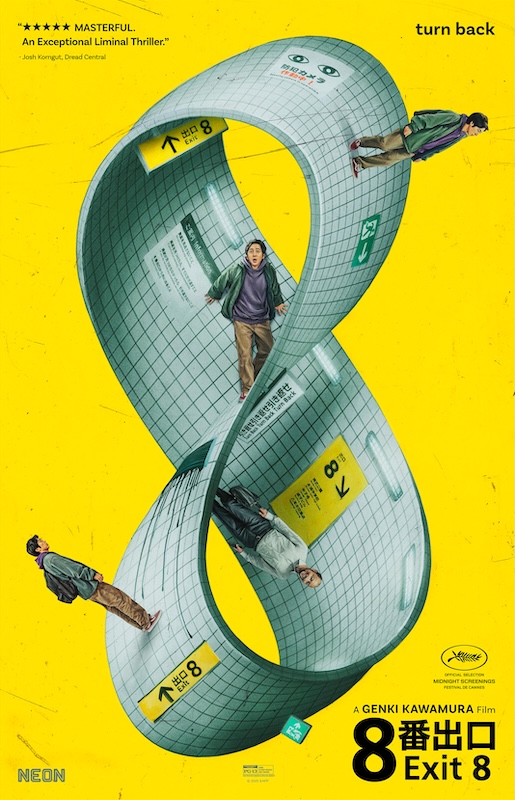
Exit 8 (2026)
Official Synopsis
Based on the hit video game created by KOTAKE CREATE, Exit 8 follows a man trapped in an endless subway passageway. To escape, he must carefully study his surroundings, turn back whenever he discovers an anomaly, and continue forward when everything appears normal. One mistake sends him back to the beginning.
William’s Review
Exit 8 takes an incredibly simple video game concept and turns it into a really engaging movie. A man is trapped inside a short subway corridor that keeps repeating. If he notices something different, he has to turn around. If everything looks normal, he continues forward. One mistake sends him back to the beginning.
That sounds like it could become repetitive very quickly. Instead, the repetition is exactly what pulls you into the movie. Once I understood the rules, I stopped watching passively and started playing along. I studied the posters, doors, vents, lights, and every person who passed through the corridor. Sometimes I noticed something before the characters did. Other times I convinced myself that a normal detail had changed.
The corridor is short enough that each reset happens quickly. The movie never wastes several minutes returning everyone to the starting point. It moves directly into the next attempt, which keeps the tension building even though we are repeatedly seeing the same location.
The setting also creates a constant sense of unease. There are no windows, no clear connection to the outside world, and very few people. Even when nothing appears to be wrong, the possibility of an anomaly makes every ordinary detail feel suspicious.
Some changes are subtle enough to make you question your memory. Others become full horror sequences involving disturbing images, loud noises, and situations that escalate far beyond a missing poster. Because the movie does not establish a predictable pattern, I never knew whether the next loop would contain a tiny difference or something much worse.
What impressed me most is how the movie adds an emotional story without abandoning the game. There are only a few important characters, and almost everything happens inside the corridor. We still learn enough about them to care whether they escape and understand that the loop may represent more than a physical puzzle.
The performances sell that emotional side, while the limited setting and simple rules keep the experience focused. Exit 8 does not merely adapt a video game. It finds a way to make the audience feel like they are playing it.
That sounds like it could become repetitive very quickly. Instead, the repetition is exactly what pulls you into the movie. Once I understood the rules, I stopped watching passively and started playing along. I studied the posters, doors, vents, lights, and every person who passed through the corridor. Sometimes I noticed something before the characters did. Other times I convinced myself that a normal detail had changed.
The corridor is short enough that each reset happens quickly. The movie never wastes several minutes returning everyone to the starting point. It moves directly into the next attempt, which keeps the tension building even though we are repeatedly seeing the same location.
The setting also creates a constant sense of unease. There are no windows, no clear connection to the outside world, and very few people. Even when nothing appears to be wrong, the possibility of an anomaly makes every ordinary detail feel suspicious.
Some changes are subtle enough to make you question your memory. Others become full horror sequences involving disturbing images, loud noises, and situations that escalate far beyond a missing poster. Because the movie does not establish a predictable pattern, I never knew whether the next loop would contain a tiny difference or something much worse.
What impressed me most is how the movie adds an emotional story without abandoning the game. There are only a few important characters, and almost everything happens inside the corridor. We still learn enough about them to care whether they escape and understand that the loop may represent more than a physical puzzle.
The performances sell that emotional side, while the limited setting and simple rules keep the experience focused. Exit 8 does not merely adapt a video game. It finds a way to make the audience feel like they are playing it.
Amy’s Review
I wish we had seen Exit 8 in a theater, but I am also glad we did not because I would not have been quiet. Once I understood the rules, I started talking directly to the characters. Turn around. That is different. Why are you still standing there? Run now. I would have become the person irritating everyone else in the theater because the movie makes it almost impossible to sit back and watch silently.
The corridor looks simple at first. There are posters, doors, lights, security cameras, and one man who repeatedly walks past. After seeing it several times, I started memorizing where everything belonged. I checked every poster and searched the walls for anything missing. William thought a vent had disappeared during one loop, and I had to explain that he was looking beside the wrong door. It really does become a memory game.
That made the repetition fun instead of annoying. I normally hate movies that count toward an ending because I become impatient whenever the number resets. There were moments when these characters lost several exits of progress, and I felt frustrated for them. I was not frustrated with the movie, though. I wanted them to notice the next anomaly and keep moving.
The small setting also made me anxious. There are no windows, almost no other people, and no way to understand where the corridor exists. The characters keep walking through the same enclosed space without knowing whether they are getting closer to freedom. I already have some claustrophobia, so the idea of being trapped there made the tension worse.
Some anomalies are small, but others are loud, disgusting, or genuinely frightening. The movie may seem quiet for several minutes before suddenly becoming full horror. I jumped more than once, and there were several visuals I did not enjoy looking at. Because I never knew what kind of change was coming, every trip through the corridor felt unsafe.
I also cared about the characters more than I expected. The movie gives us pieces of their lives without leaving the corridor for long explanations. Their reasons for escaping gradually become just as important as solving the puzzle.
My one practical complaint is that someone who needs an inhaler that often should keep it in his pocket, not buried inside a backpack. Aside from that irritation, I was completely involved. I finished the movie wanting to discuss what everything meant and find out whether we could play the game ourselves.
The corridor looks simple at first. There are posters, doors, lights, security cameras, and one man who repeatedly walks past. After seeing it several times, I started memorizing where everything belonged. I checked every poster and searched the walls for anything missing. William thought a vent had disappeared during one loop, and I had to explain that he was looking beside the wrong door. It really does become a memory game.
That made the repetition fun instead of annoying. I normally hate movies that count toward an ending because I become impatient whenever the number resets. There were moments when these characters lost several exits of progress, and I felt frustrated for them. I was not frustrated with the movie, though. I wanted them to notice the next anomaly and keep moving.
The small setting also made me anxious. There are no windows, almost no other people, and no way to understand where the corridor exists. The characters keep walking through the same enclosed space without knowing whether they are getting closer to freedom. I already have some claustrophobia, so the idea of being trapped there made the tension worse.
Some anomalies are small, but others are loud, disgusting, or genuinely frightening. The movie may seem quiet for several minutes before suddenly becoming full horror. I jumped more than once, and there were several visuals I did not enjoy looking at. Because I never knew what kind of change was coming, every trip through the corridor felt unsafe.
I also cared about the characters more than I expected. The movie gives us pieces of their lives without leaving the corridor for long explanations. Their reasons for escaping gradually become just as important as solving the puzzle.
My one practical complaint is that someone who needs an inhaler that often should keep it in his pocket, not buried inside a backpack. Aside from that irritation, I was completely involved. I finished the movie wanting to discuss what everything meant and find out whether we could play the game ourselves.